
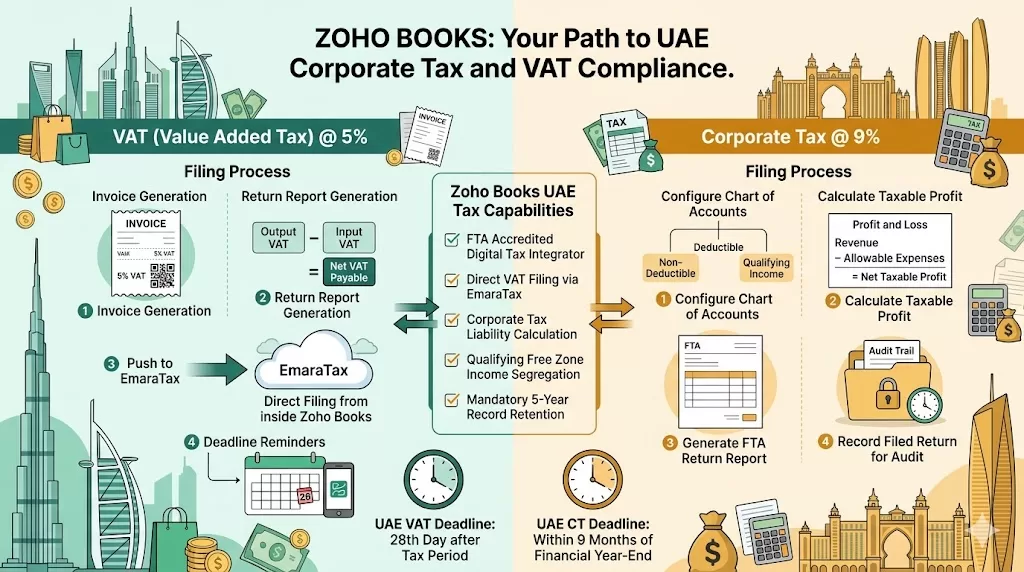
Two separate tax obligations. One accounting system. And most UAE businesses are not fully configured for either.
UAE Corporate Tax came into effect on 1 June 2023. Every business with taxable net profit above AED 375,000 is now subject to a 9% tax rate. VAT has been running since 2018 at 5%. Most businesses think they are compliant. Many are not fully configured.
Zoho Books UAE Corporate Tax compliance is built into the platform. It works correctly only when the system is set up to reflect your actual business structure. This guide covers what UAE tax compliance requires, how Zoho Books handles both Corporate Tax and VAT, and what a correct configuration looks like in practice.
Who Does UAE Corporate Tax Apply To?
Corporate Tax is a direct tax on net business profit. It applies to all UAE businesses with profits exceeding AED 375,000 per financial year, effective from financial years starting on or after 1 June 2023.
UAE Corporate Tax Rates
| Taxable Income | Tax Rate |
| Up to AED 375,000 | 0% |
| Above AED 375,000 | 9% |
| Qualifying Free Zone income | 0% (conditions apply) |
| Large multinationals (Pillar Two) | 15% (specific scope) |
The 9% rate applies to net profit, not revenue. A business generating AED 5 million in revenue but spending AED 4.8 million in allowable expenses pays Corporate Tax on AED 200,000, which falls below the AED 375,000 threshold.
Who Must Register for Corporate Tax
All UAE resident businesses must register for Corporate Tax through the FTA’s EmaraTax portal, even if their taxable income falls below the threshold. Registration is mandatory. The timing of your first return depends on your financial year-end.
Is Zoho Books FTA Approved?
Yes. Zoho Books is officially recognised by the UAE Federal Tax Authority as a Digital Tax Integrator: the FTA’s accreditation for accounting software that connects directly to the EmaraTax portal.
Zoho Books UAE Corporate Tax features are available across supported plan tiers. The platform handles:
- Corporate Tax liability calculation based on net profit
- Corporate Tax return generation aligned to FTA reporting format
- Record keeping for the mandatory 5-year retention period
- Audit trail for all transactions and tax adjustments
Zoho Books UAE VAT capabilities include:
- Direct VAT return filing to the EmaraTax portal with a single push
- VAT return pulling from EmaraTax to reconcile what was filed versus what was generated
- FTA-compliant tax invoice generation with all mandatory fields
- Voluntary disclosure submission for corrections to previously filed returns
As of 2025, Zoho Books allows VAT returns to be submitted directly from inside the software to EmaraTax without switching platforms or manually entering data.
How to Configure UAE Corporate Tax in Zoho Books
Before configuring Corporate Tax in Zoho Books, the business must be registered for Corporate Tax in the EmaraTax portal. The Tax Registration Number (TRN) issued by the Ministry of Finance is required for setup.
Step-by-Step Corporate Tax Setup
Zoho Books can easily integrate into your tax setup using 6 simple steps.
Step 1: Enable Corporate Tax
Go to Settings, select Taxes under Taxes and Compliance, select Corporate Tax, and slide the toggle next to “Are you liable to Corporate Tax?” to Yes.
Step 2: Enter Your TRN
Input the Tax Registration Number issued during EmaraTax registration. An incorrect TRN will cause recognition failures at the point of filing. Always verify the TRN format before saving.
Step 3: Configure Your Chart of Accounts
The Chart of Accounts must be structured to separate taxable income, non-taxable income, deductible expenses, and non-deductible expenses. Non-deductible items, such as 50% of entertainment costs under UAE Corporate Tax rules, must be categorised correctly so the system calculates taxable profit accurately.
Step 4: Set Up Free Zone Income Tracking (if applicable)
Free Zone businesses maintaining Qualifying Free Zone Person status must segregate Qualifying Income (taxed at 0%) from non-qualifying income (taxed at 9%). Zoho Books tracking categories handle this separation at the transaction level.
Step 5: Generate and Review Tax Return
Navigate to Corporate Tax, select Tax Returns, and choose Generate. Zoho Books produces the return based on ledger data. Review taxable income, deductions, and exemptions before finalising.
Step 6: File via EmaraTax
The Corporate Tax return is not filed directly from Zoho Books in the same way VAT is. Zoho Books generates a report that mirrors the FTA return layout. The figures are then entered into the EmaraTax portal. Zoho Books stores a filed record for audit purposes.
UAE VAT Configuration in Zoho Books
Zoho Books UAE VAT configuration covers every aspect of UAE’s 5% VAT framework. VAT registration is mandatory for businesses with taxable sales and imports exceeding AED 375,000 in the past 12 months or the upcoming 30 days.
VAT Tax Rates in Zoho Books
| Rate | Application |
| Standard Rate (5%) | Most goods and services in the UAE |
| Zero Rate (0%) | Exports, international transport, healthcare and education |
| Exempt | Bare land, residential property and local passenger transport |
| Out of Scope | Transactions outside the UAE VAT jurisdiction |
Zoho Books auto-populates the appropriate tax rate based on your configuration. Transactions involving the reverse charge mechanism are explicitly identified on documents.
Setting Up UAE VAT
The UAE VAT setup in Zoho Books requires:
- VAT registration number (TRN) entered under organisation settings
- Tax period assigned: monthly or quarterly, as specified by the FTA
- Customer and vendor categories: VAT-registered UAE entities, non-VAT registered UAE entities, and non-GCC entities each have different VAT treatment
- Place of supply rules configured for transactions involving goods and services crossing UAE emirate or international boundaries
Filing Your UAE VAT Return via EmaraTax
Zoho Books is a recognised Digital Tax Integrator by the Federal Tax Authority. VAT returns can be filed directly from inside Zoho Books to the EmaraTax portal.
The VAT Filing Process in Zoho Books
File your VAT with Zoho Books using 4 simple steps.
Step 1: Generate the VAT Return Report
Select the tax period and generate the VAT return report. Zoho Books calculates output VAT, input VAT, and net VAT payable based on all transactions in the period.
Step 2: Review and Lock
Review taxable amounts and tax amounts on standard-rated supplies with a drill-down by Emirate. Lock the draft report after verifying. A locked report cannot be edited without unlocking, creating an audit trail.
Step 3: Push to EmaraTax
Submit directly to the EmaraTax portal from within Zoho Books. The VAT 201 report is filed without switching platforms or manually entering data into EmaraTax fields.
Step 4: Reconcile Filed vs Generated
Pull VAT returns from EmaraTax into Zoho Books, including returns filed through other channels. This reconciliation step identifies mismatches between what was generated and what was filed.
UAE VAT Filing Deadlines
The deadline to file a UAE VAT return is the 28th day of the month following the end of the tax period. A business with a quarterly tax period ending 31 March must file by 28 April. Zoho Books includes deadline reminders built into the platform.
Free Zone Businesses and Corporate Tax in Zoho Books
Free Zone businesses represent one of the most common Corporate Tax configuration challenges in Zoho Books Dubai and Abu Dhabi implementations. The rules are specific, and the consequences of misconfiguration are material.
Qualifying Free Zone Person Status
A Free Zone business maintaining Qualifying Free Zone Person status pays 0% Corporate Tax on Qualifying Income. Qualifying Income includes income from transactions with other Free Zone persons and certain international transactions. Non-qualifying income, such as income from UAE mainland customers, is taxed at 9%.
How Zoho Books Handles Free Zone Income Separation
Zoho Books tracking categories are used to segregate Qualifying Income from non-qualifying income at the transaction level. This separation must be consistent across every sales transaction. A Free Zone business that does not categorise transactions correctly risks losing Qualifying Free Zone Person status, which triggers 9% tax on all income retroactively.
The configuration requires careful Chart of Accounts design from the start. It is not a change that can be made easily after transactions have been recorded.
Corporate Tax Reports Zoho Books Generates
Zoho Books FTA-approved reporting tools produce the documents needed for Corporate Tax compliance and FTA audit readiness.
Key Reports for UAE Corporate Tax
- Profit and Loss Statement: The foundation of any Corporate Tax calculation. Zoho Books produces this from all recorded transactions.
- Corporate Tax Return Report: Mirrors the layout of the FTA’s CT return form, with taxable income, deductions, exemptions, and tax liability calculated.
- Audit Trail Report: Every transaction recorded, with timestamps and user activity logs, for the mandatory 5-year retention period.
- Tracking Category Report: Segregation of Qualifying and non-qualifying income for Free Zone businesses.
All reports are downloadable for audit submission. Amendments to filed returns are managed through Voluntary Disclosures, which Zoho Books supports for both Corporate Tax and VAT corrections.
UAE E-Invoicing: What Zoho Books Users Need to Know Now
The UAE is introducing mandatory e-invoicing in phases from 2026. Pilot adoption begins on 1 July 2026 for large taxpayers with annual revenue above AED 50 million. Mandatory compliance extends to SMEs with revenue below AED 50 million from 1 July 2027.
The UAE e-invoicing framework uses the PINT AE data standard and requires integration with an Accredited Service Provider (ASP) and the FTA’s OpenPeppol network.
This is a different technical architecture from Saudi Arabia’s ZATCA Fatoorah system. Businesses using Zoho Books Dubai and broader UAE operations should begin preparing their Chart of Accounts and invoice templates now, before mandatory deadlines apply.
A dedicated UAE e-invoicing configuration guide from Al Fahad will follow as the FTA’s implementation timeline firms up.
UAE Corporate Tax Filing Deadlines and Penalties
Corporate Tax returns must be filed within nine months of the financial year-end. A business with a financial year ending 31 December 2024 must file by 30 September 2025.
Penalty Framework
| Violation | Penalty |
| Late filing | AED 10,000 + 1% of unpaid tax per month |
| Failure to maintain records | AED 10,000 per violation |
| Incorrect return: understated tax | 50% of the understated amount |
| Failure to register for Corporate Tax | AED 10,000 |
Zoho Books includes built-in deadline reminders and an automated calculation framework that reduces the risk of understated tax through miscategorisation.
What a Compliant Zoho Books UAE Setup Involves
Getting Zoho Books UAE Corporate Tax configuration right from the start prevents the compounding problems that come from incorrect setup. A Chart of Accounts that does not separate non-deductible expenses correctly produces understated taxable income. A Free Zone business that does not separate Qualifying Income correctly risks losing its 0% rate.
Our Zoho Premium Partner team has active UAE Corporate Tax and VAT implementation experience across Dubai, Abu Dhabi, and UAE free zones, including JAFZA, DIFC, and DAFZA.
Every UAE Zoho Books implementation at Al Fahad covers:
- Organisation setup and TRN configuration
- Chart of Accounts design aligned to UAE Corporate Tax reporting requirements
- Free zone income separation using tracking categories
- EmaraTax VAT direct filing setup and testing
- Corporate Tax return generation and review process training
- Staff training for finance teams in Arabic and English
Businesses evaluating the cost of a proper Zoho Books implementation alongside their broader accounting software investment can reference our guide on Oracle ERP system cost in the UAE for comparative context across enterprise accounting platforms.
Frequently Asked Questions
Does UAE Corporate Tax apply to my Dubai business?
UAE Corporate Tax applies to all UAE resident businesses with taxable net profit exceeding AED 375,000, from the first financial year starting on or after 1 June 2023. Registration is mandatory for all businesses regardless of profit level. Zoho Books UAE Corporate Tax features are available on supported plan tiers.
Can Zoho Books file VAT returns directly with the FTA?
Yes. Zoho Books is recognised as a Digital Tax Integrator by the Federal Tax Authority. As of 2025, VAT returns can be generated and submitted directly to the EmaraTax portal from inside Zoho Books UAE VAT, without switching platforms or manually entering figures into EmaraTax fields.
My business is in a UAE free zone. Do I still pay 9% Corporate Tax?
Free Zone businesses maintaining Qualifying Free Zone Person status pay 0% Corporate Tax on Qualifying Income. Income from mainland UAE customers is subject to 9%. Zoho Books tracking categories handle the separation, but the Chart of Accounts must be configured correctly from the start. Misconfiguration creates retroactive tax risk.
What is the deadline for UAE Corporate Tax returns?
Returns must be filed within nine months of the financial year-end. A business with a December 31 year-end must file by September 30 of the following year. Late filing incurs AED 10,000 plus 1% of the unpaid tax per month. Zoho Books Dubai and UAE businesses can use built-in deadline reminders to avoid penalties.
Can Zoho Books handle both VAT and Corporate Tax for the same organisation?
A single Zoho Books organisation handles both obligations. VAT filing is handled through direct EmaraTax integration. Corporate Tax returns are generated in Zoho Books and filed through the EmaraTax portal. Both use the same underlying transaction data, eliminating duplicate data entry between the two compliance workflows.
How does Zoho Books UAE Corporate Tax compare to the ZATCA setup in Saudi Arabia?
UAE Corporate Tax and Saudi ZATCA Phase 2 are entirely different compliance frameworks. ZATCA requires real-time invoice clearance via the Fatoorah portal. UAE Corporate Tax requires annual return filing based on net profit.
Both are handled within their respective regional editions of Zoho Books. Our guide on Zoho Books ZATCA Phase 2 Saudi Arabia covers the Saudi configuration in detail.
Get Your Zoho Books UAE Tax Configuration Right
Zoho Books UAE Corporate Tax and VAT compliance is built into the platform. The platform only protects your business when the configuration reflects your actual structure: entity type, free zone status, Chart of Accounts design, and filing preferences.
Al Fahad IT Consulting is a Zoho Premium Partner with active UAE implementation experience. Our team configures, tests, and supports Zoho Books for UAE Corporate Tax and VAT compliance across Dubai, Abu Dhabi, Sharjah, and UAE free zones.
Talk to our Zoho Books UAE team →
نتحدث العربية. تواصل معنا عبر واتساب للحصول على استشارة مجانية في تهيئة زوهو بوكس للضريبة الاتحادية الإماراتية
Al Fahad IT Consulting is a Zoho Premium Partner and Oracle Partner Network member, providing Zoho Books implementation and UAE tax compliance services across the UAE, Saudi Arabia, and Bahrain.


